SoundCloud
Open SoundCloud ↗2020 · Solo piano
Temporal Streams
Three sharply focused materials become extended temporal conditions, each sheltering an outlier whose belonging remains deliberately unresolved.
Listen / watch
Performance
Perusal
Inside the score
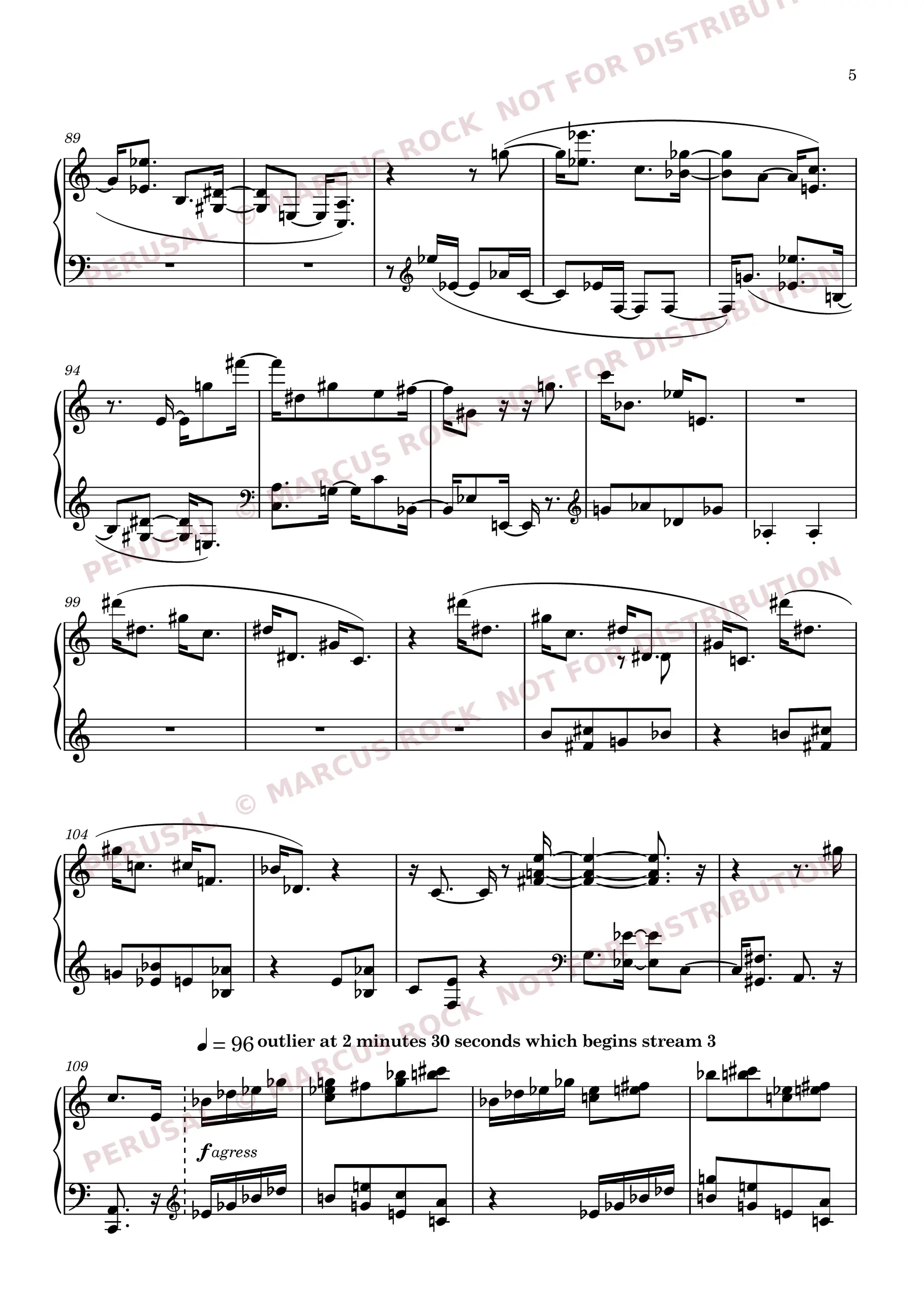
Page 5 holds the suspended close of the second stream against the aggressive event identified simultaneously as the third stream’s outlier and its point of entry.
- Year
- 2020
- Forces
- Solo piano
- Duration
- 5′00″–10′00″ · variable tempi
- Instrumentation
- Solo piano
About the work
26 / 30Programme note
Temporal Streams organises solo piano writing into three extended streams, each governed by a sharply focused behaviour and each carrying an outlier whose membership is deliberately undecidable. The work is less concerned with transforming these materials than with establishing them as temporal conditions. Figuration, harmony and articulation provide recognisable surfaces; the deeper subject is stasis—how long a condition can remain present, how attention alters while it lasts, and when persistence begins to sound like change even though its constituent material has barely moved.
The first stream is made from clipped chromatic cells, articulated sempre staccato and cast between the pianist’s hands in irregular bursts. Rests puncture its continuity without clearing the field: every re-entry feels like the same mechanism resuming after a momentary suspension. Tempo, register and articulation bend, but the stream retains its brittle identity. Its outlier arrives at a slower tempo and fff, compressing accented, non-legato figures into a brief eruption before the texture separates once more into registral traces. It may be an intrusion, a latent extremity of the first stream, or an early glimpse of something not yet classifiable.
At the one-minute marker, the second stream replaces fracture with resonance. The score asks for muted, bell-like sonorities, an impressionistic colour and freely used pedal. Isolated notes, curved fragments and chordal shadows are separated by air, so decay and silence occupy as much structural weight as attack. Its outlier thickens this suspended field into a more continuous, intertwined activity; yet the surrounding sonority is not cancelled. The stream lingers long enough for contrast itself to become ambiguous: the listener may hear a foreign object, an intensification of what was already present, or a boundary that exists only because the score names it.
At two minutes and thirty seconds, an aggressive expansion is designated both as an outlier and as the beginning of the third stream, making the border between exception and new condition impossible to fix. The stream proper then settles into long spans of almost unbroken chromatic motion, initially staccato and later passing through legato and renewed articulation without surrendering its underlying current. It occupies most of the score’s physical and temporal space. Through that disproportion, rapid figuration ceases to behave as foreground information and becomes an environment—a stasis made from movement. At the terminal five-minute marker, massed chords announce that a ‘new stream begins’ rather than supplying a cadence. The frame therefore opens beyond itself: material remains provisional, while elapsed time becomes the work’s most consequential form.
Temporal Streams exists in several score versions, each recalibrating the work’s temporal proportions. The recording and the score displayed here therefore document different temporalities: events, streams and outliers may occur at substantially different moments, while their durations and points of collision may also shift. These differences are intentional rather than deviations from a single fixed chronology; each version reorganises the same materials around a distinct experience of elapsed time.
History
Credits & performances
- Performer
- Michaela Livadiotis, piano
Score & materials
Request the complete score.
For perusal, programming, performance materials or technical questions about this work, send a direct enquiry.