2021 · String trio
Transient Frameworks
A cognitive drama in which concentration, reverie and instability form, dissolve and prefigure one another while intrusive open strings repeatedly seize the field of attention.
Perusal
Inside the score
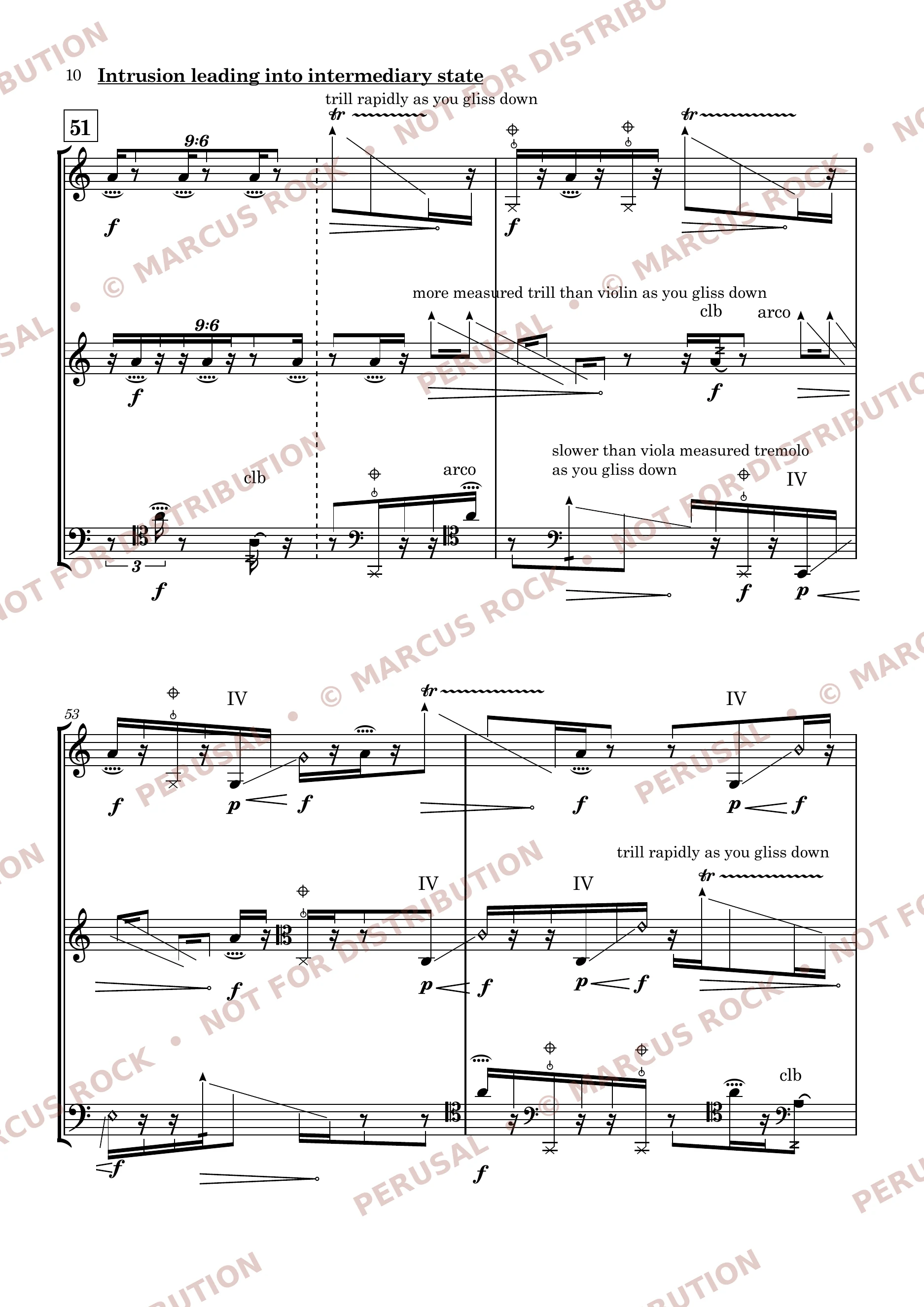
Selected pages are shown for private perusal. Full scores and performance materials are available by enquiry.
- Year
- 2021
- Forces
- String trio
- Duration
- c. 10′00″
- Instrumentation
- Violin, viola and cello
About the work
25 / 30Programme note
Transient Frameworks treats the string trio as an observational model of cognition. Its title carries a double temporality: a mental framework is never fixed, but continually reshaped by intrinsic and extrinsic forces; at the same time, any framework is temporary, disappearing from the foreground of consciousness as attention moves elsewhere. Rather than describing a mind from outside, the music follows the way concentration, distraction and sensation organise what can be heard at any given moment.
The opening, Frame A: ruminative, begins as a searching physical action. The players enter gradually, glissing continuously on a single string as though feeling their way towards pitches that never quite settle, while abrupt changes of dynamic expose momentary objects of attention. That continuity is punctured by an Intrusion: a repeated open A, marked sharp and lucid. Similar intrusions behave like intrusive thoughts. Their material is minimal, yet recurrence gives them the power to seize the entire field. The intermediary state that follows is more than a transition. It is a void in which half-formed materials circulate; once consciousness notices it, the passage between frameworks begins to resemble a framework in its own right.
These states do not arrive as sealed sections. Materials belonging to later frames appear before their headings, as though an idea were entering awareness before it could be named. Frame B suspends the trio between stasis and dense, heavy structures; the oneiric return of Frame A converts the original search into high harmonics, unstable string changes and widening vibrato. Frame C becomes light and day-dreamish, Frame D weightless and refined, and Frame E unstable and intense. Muted Bartók pizzicati, pitchless col legno, thrown bowing, glissandi and changing contact points make cognition audible as pressure, friction and focus rather than as a succession of themes. Although these materials acquire emotional weight, the score asks the players to present them with an objective, unsentimental directness: as narrators of mental action rather than characters overwhelmed by it.
In the final third, Frame E’s connected intensity is arrested by another intrusion and intermediary state. From that rupture, the opening framework reassembles as Frame A: ruminative but with more intensity, before Frame B returns with less dense structures. Those changed qualifiers are decisive. The work does not circle back to recover an original condition; returning awareness has been modified by every state through which it has passed. Its closing high pitches, widening vibrato and collective crescendo leave the framework at maximum pressure—still transforming at the moment the score ends.
Score & materials
Request the complete score.
For perusal, programming, performance materials or technical questions about this work, send a direct enquiry.