2022 · Violin & harpsichord
Melody II
A mutable lyric line passes between muted violin and precisely registered harpsichord, moving from suspended stillness through dance, timbral friction and accelerating release.
Perusal
Inside the score
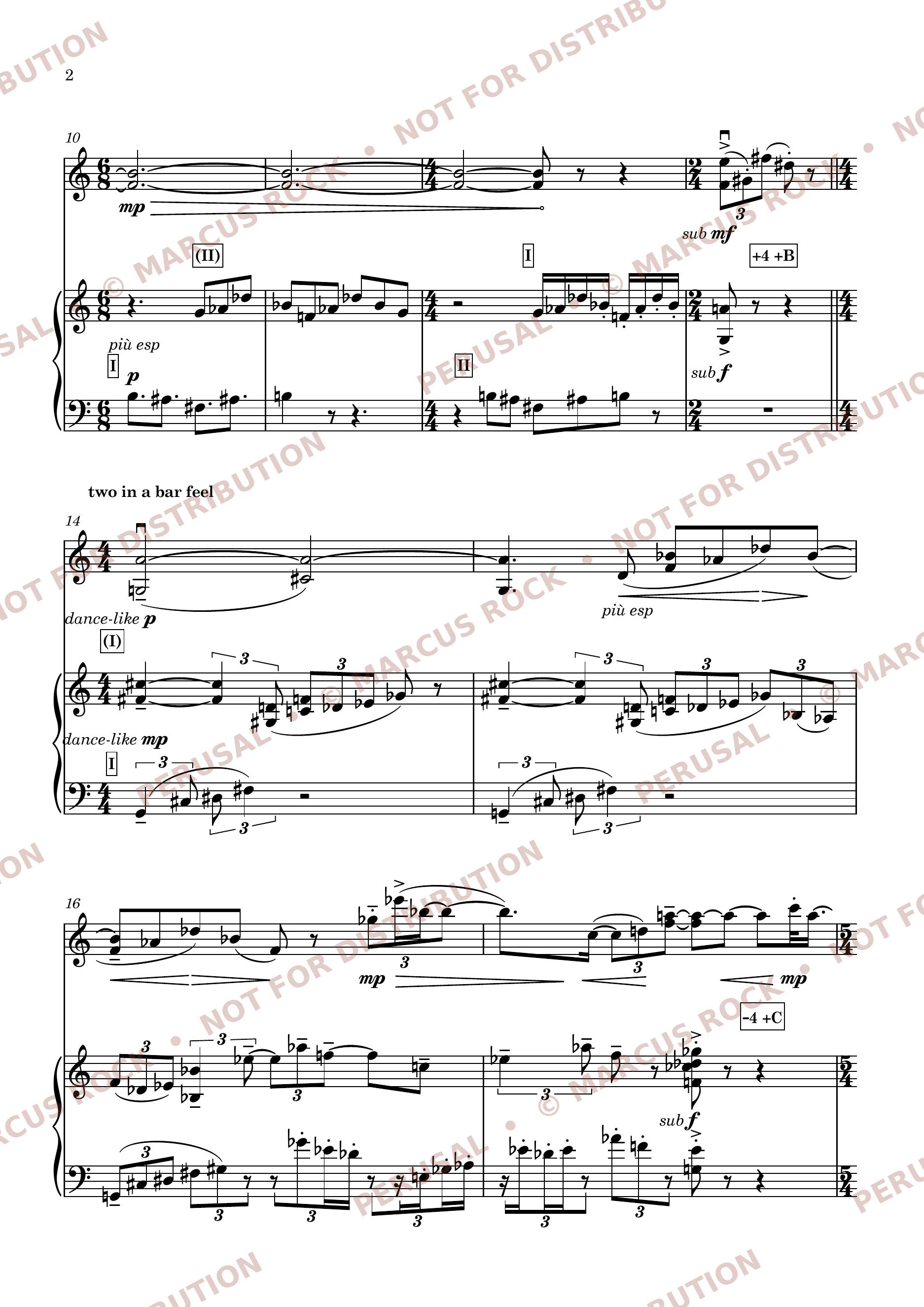
Selected pages are shown for private perusal. Full scores and performance materials are available by enquiry.
- Year
- 2022
- Forces
- Violin & harpsichord
- Duration
- c. 3′10″
- Instrumentation
- Violin and two-manual harpsichord: upper 8′; lower 8′ with buff stop and 4′; coupler, or a comparable disposition capable of reproducing the prescribed colours
About the work
21 / 30Programme note
Melody II resists a fixed division between soloist and accompaniment. The harpsichord opens alone, marked ‘tranquil but lyric’, establishing a fluid contrapuntal field before the muted violin enters with still, long-breathed tones, senza vibrato and almost imperceptible bow changes. One instrument articulates while the other suspends; then those functions pass between them. Melody is produced through their contact—extended, interrupted, refracted and repeatedly handed back in altered form.
Harpsichord registration is therefore a structural parameter rather than decorative colour. The score is conceived for two manuals: a clear 8′ upper manual; a lower manual carrying 8′ with buff and a 4′ register; and a coupler. Precisely timed changes of manual, buff, 4′ and coupling alter the perceived distance and weight of recurring gestures. The buffed lower manual gives the line a veiled, intimate grain; the 4′ adds a bright upper edge; coupled sonorities deepen and project the instrument’s body. Because the harpsichord cannot shape a sustained note through pressure in the manner of the violin, these registrations become its way of breathing, receding and coming into relief.
The opening stillness gradually acquires a two-in-a-bar, dance-like lift. The violin moves from restrained sustain towards greater expressivity, then destabilises its own tone through a natural-harmonic timbre trill whose speed expands and contracts. The harpsichord answers by changing the acoustic surface beneath it: spare continuo-like support, delicate manual exchanges, animated counterpoint and denser coupled resonance. In the later climax the violin is explicitly asked not to overpower the dying harpsichord sound, making decay itself a moment of ensemble balance. Earlier lyric material then returns inside a more pressurised flow.
At the close, the music accelerates to ♩=150 before opening into free tempo. A brilliant fff harpsichord sonority—4′ and coupled manuals without the buff—releases into its inevitable decay while the violin’s harmonic trill gradually slows and disappears. The two instruments end together without sharing the same physical time: one disperses after impact, the other sustains an instability until motion can no longer be maintained.
History
Credits & performances
- Commissioned by
- Cheltenham Music Festival
- World premiere
- Mahan Esfahani, harpsichord · Fenella Humphreys, violin · Cheltenham Music Festival
Score & materials
Request the complete score.
For perusal, programming, performance materials or technical questions about this work, send a direct enquiry.