SoundCloud
Open SoundCloud ↗2026 · Electronic work / DAW
Leakage
Two sonic rooms leak into one another, forced into coexistence without surrendering their distinct contours.
Listen / watch
Recording
Project
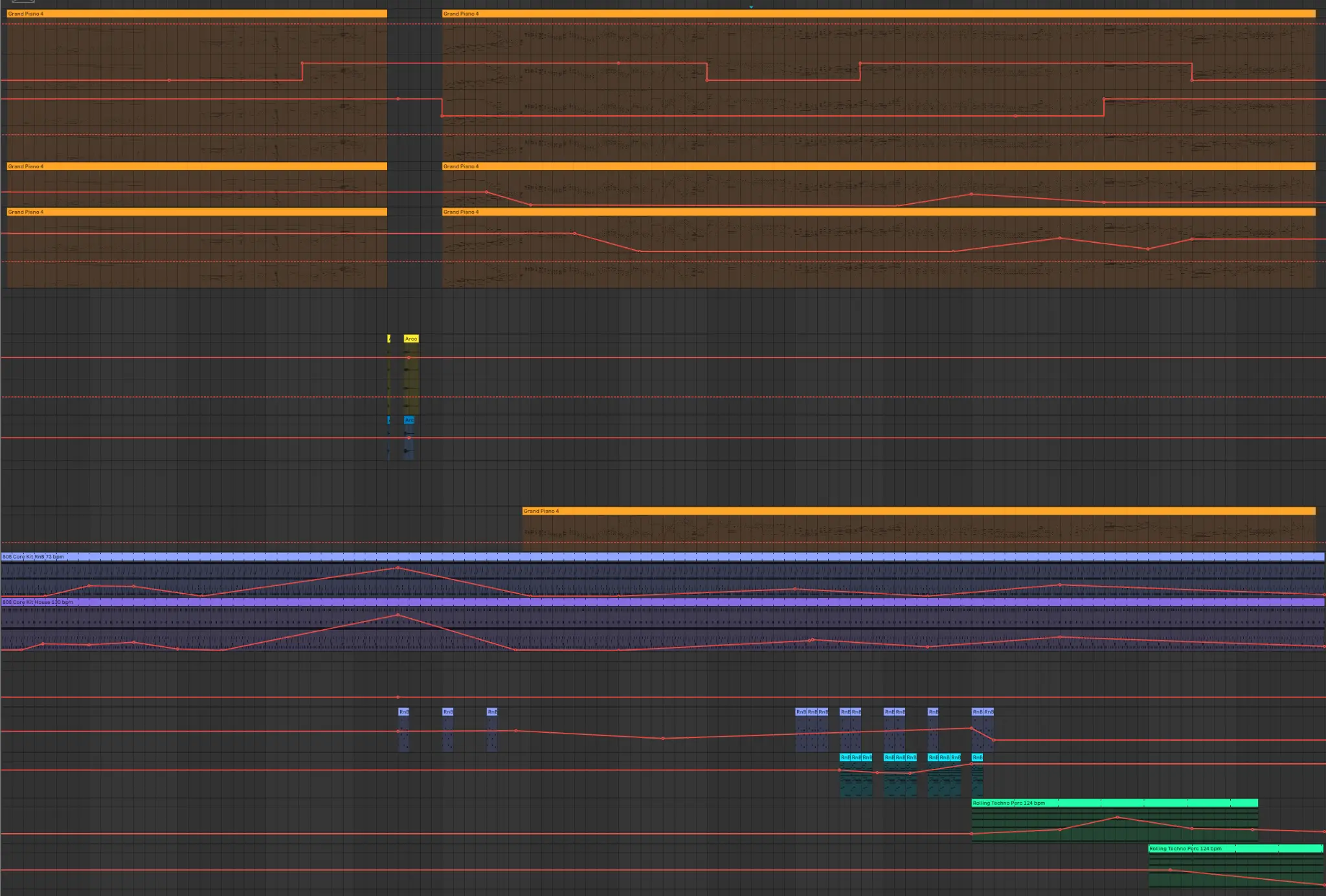
Inside the session
The Ableton Live arrangement reveals the two sonic rooms and the automation governing their points of contact.
- Year
- 2026
- Forces
- Electronic work / DAW
- Duration
- 8′00″
- Instrumentation
- Electronic work composed and realised in Ableton Live
About the work
28 / 30Programme note
Leakage stages two sonic rooms that leak into one another and are forced to coexist without ever changing the other’s contours. One is inspired by the density and profusion of Sorabji-esque keyboard writing, articulated through harpsichord, gongs and free tempi. The other is more repetitive and bodily, drawing on dance music, heavy percussion and insistent rhythm. Together they create a rhythmic clash between acoustic and electronic styles.
Materials from each space cross an unstable boundary and become audible inside the other without assimilating to it. Their overlap produces friction, interference and accidental synchrony, yet neither field resolves into a shared language. Coexistence is heard as sustained proximity: two environments remaining distinct even as each becomes impossible to hear without the other.
Continuing an exploration begun in Improv 1, Leakage also looks backward through histories of electronic imitation. Its deliberately raw, glitch-prone sonorities recall 8-bit game sound and early film soundtracks in which limited electronic means point towards acoustic instrumentation without fully reproducing it. Rather than treating the failure of the copy as a weakness, the work values it as a kind of historical grain: the mechanism of reproduction remains audible.
Within this field, piano appears as an acoustic audio skin applied to MIDI, while harpsichord and overtone-rich gongs place traces of human performance and instrumental history in the room with electronic sound. The harpsichord and piano suggest a continuum between earlier keyboard mechanisms and the polished modern piano timbre; the gongs blur the boundary between sampled resonance and synthetic spectrum. These sounds do not reconcile the two rooms. They make the boundary harder to locate.