YouTube
Open YouTube ↗2026 · Chamber ensemble · 7 players
Glass Trees
Across Umbral Sand and Lurid Vapour, seven bodies enter a climate where noise behaves like weather, pitches flicker at the limits of hearing and every sound is caught becoming something else.
Listen / watch
Performance
Perusal
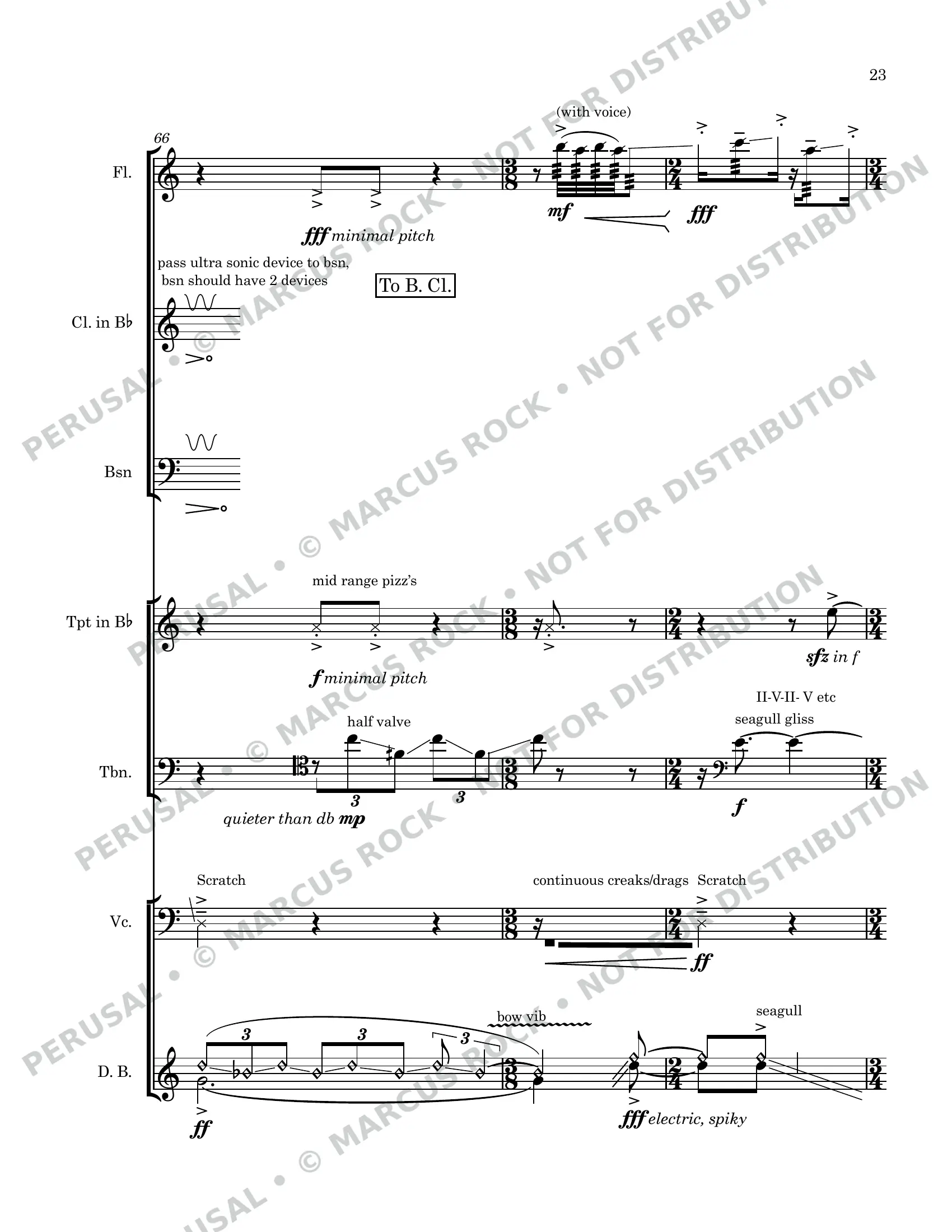
Inside the score
Selected pages are shown for private perusal. Full scores and performance materials are available by enquiry.
- Year
- 2026
- Forces
- Chamber ensemble · 7 players
- Duration
- 13′20″–13′40″
- Instrumentation
- Flute (doubling piccolo and bass flute); B♭ clarinet (doubling bass clarinet); bassoon; B♭ trumpet; trombone; cello; double bass with C extension; and two ultrasonic devices shared among the woodwind players
About the work
01 / 30Programme note
Glass Trees is a work for seven players in two movements, Umbral Sand and Lurid Vapour. Scored for flute doubling piccolo and bass flute, B♭ clarinet doubling bass clarinet, bassoon, B♭ trumpet, trombone, cello, double bass with C extension, and two ultrasonic devices shared among the woodwind players, it treats the ensemble as a field of breath, resonance, friction and interference.
The piece begins from almost imperceptible pitchless sibilance, diaphragm pulses, tongue movements and an acousmatic high-frequency pulse, before gradually exposing more tactile instrumental behaviours: percussive attacks, multiphonic flickers, valve and slide vibrations, bow creaks, col legno, harmonic glissandi, buzzing preparations and microtonal beating.
The musical discourse emerges from a notational dialogue between freedom and precision. The conductor shapes gestural contours and alignment while players retain agency over entrances, pauses and degrees of textural prominence.
Across the two movements, sound remains a malleable material in continuous development: breath becomes pulse; pulse becomes distortion; sustained tones fracture into noise, harmonics, tremor and unstable resonance. These transformations propel a dramaturgy of charged acoustic environments and shifting sonic hierarchies—sometimes sparse and exposed, sometimes densely agitated and volatile. Pitch gradually acquires presence until the work culminates in an expansion into a lurid field of resonance, where the ensemble’s full force and the acoustic of the space can finally be felt.
History
Credits & performances
- Commission
- Columbia Composers
- World premiere
- International Contemporary Ensemble · St. Paul’s Chapel, New York · 24 March 2026
Score & materials
Request the complete score.
For perusal, programming, performance materials or technical questions about this work, send a direct enquiry.