YouTube
Open YouTube ↗2023 · Chamber orchestra with soprano
Tulpa
A volatile procession of imagined beings in which orchestral colour acquires voice, multiplies across bodies and finally dissolves into breath, friction and white noise.
Listen / watch
Performance
Perusal
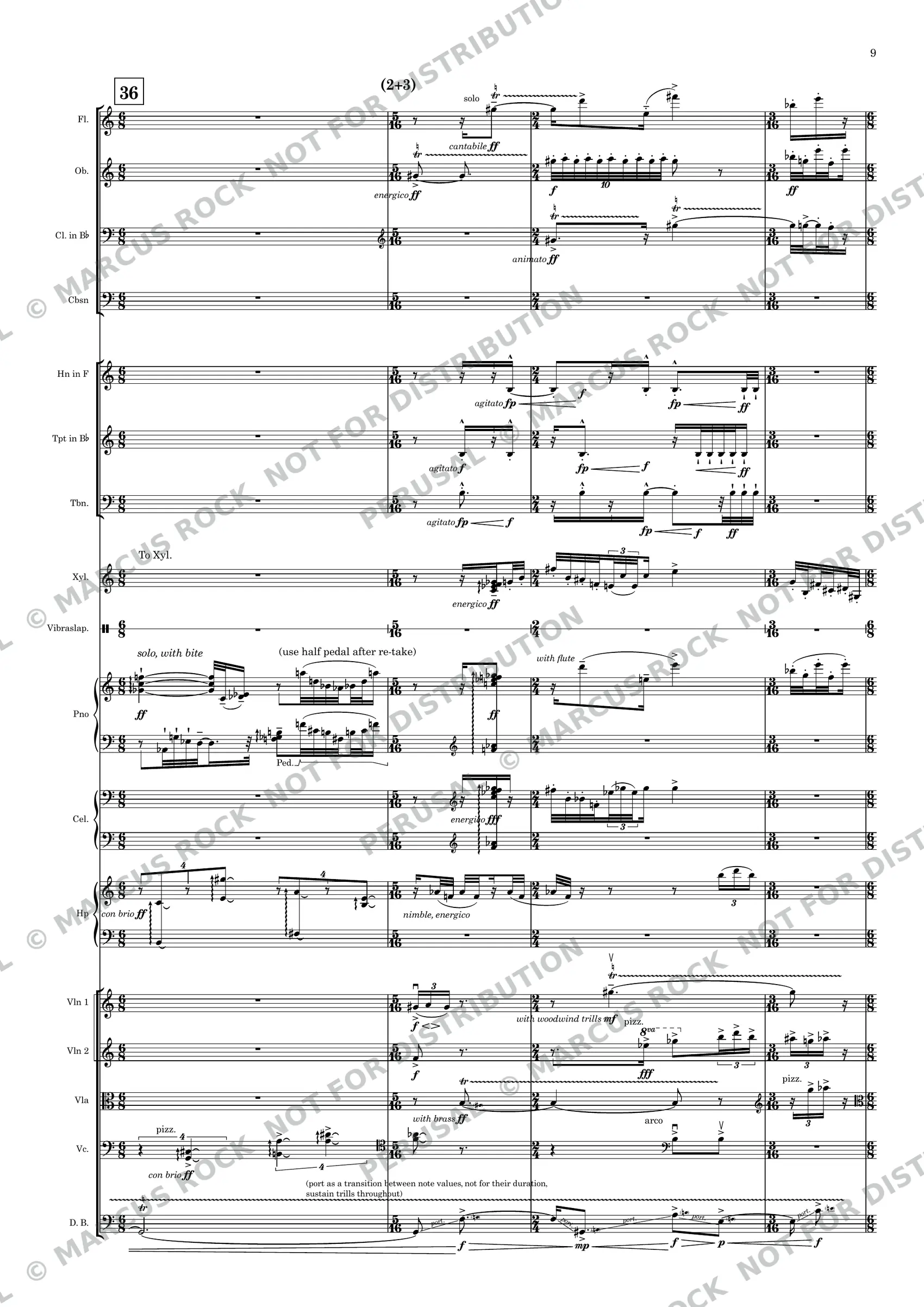
Inside the score
Selected pages are shown for private perusal. Full scores and performance materials are available by enquiry.
- Year
- 2023
- Forces
- Chamber orchestra with soprano
- Duration
- c. 5′30″
- Instrumentation
- Full instrumentation available on request
About the work
10 / 30Programme note
Tulpa was born from the composer’s reconsideration of material first assembled in Streams (Sketch) (2022), a work formed by reconciling a week of daily chamber-orchestral studies. Its pitchless breath, migrating timbres, improvised vocality and contrasting textural streams are not quoted intact; they are reimagined as the behaviours of temporary imagined bodies. Tulpa therefore treats orchestration not as the colouring of pre-existing material, but as a means of giving those bodies acoustic presence. A tulpa can be understood as a sensory phenomenon produced through imagination: something heard or seen with intensity despite having no independent physical existence. The work forms its musical material from unstable conjunctions of timbre, articulation and register. Its opening—marked ‘Pesante, yet Animato’—already holds incompatible states together. Pitchless breath, overblown squeaks, brushed resonance, whispered voice, high-frequency string glissandi and dry instrumental points flicker into view as though several presences were being perceived before any one of them could become whole.
These presences acquire characters by migrating between bodies: playfulness becomes warmth, warmth becomes something thunderous or grotesque; a timbre trill becomes tongued articulation; the soprano seems to emerge from instrumental colour and instrumental colour begins to behave like speech. Meditative suspensions and tranquil high-frequency fields repeatedly open inside more agitated counterpoint, so the listener’s position keeps changing. At times the music observes its thought-forms from outside; at others it seems to enter their interior life, or to become a quasi-narrative commentary upon their interactions.
The most radical shift follows the first orchestral climax. At the instruction ‘singer takes centre stage’, the large ensemble withdraws and temporal authority passes to the soprano. The conductor visibly stops beating while a rhapsodic, improvisatory monologue moves through breath, rolled consonants, vowels and invented syllables. When conducting resumes, the voice hardens into scat-like rhythm and Sprechstimme whisper before the orchestra gradually rebuilds around it. What had belonged to one body then becomes contagious: instrumentalists imitate the soprano’s whispered ‘sssaa’; contrasting voices and accents accumulate; the word ‘tulpa’ is repeated ad libitum until it no longer names an apparition but becomes the material of a collective ritual. Observer, entity and commentary collapse into one another.
From this multiplication the score drives into its Relentless, Sostenuto e Colossale and Più Colossale spans, where foot stamps, manic speech, fanfare, percussion and saturated instrumental motion give the imagined body overwhelming physical weight. Yet the ending refuses a stable monument. After the final ‘Risoluto’ gestures, pitch is stripped away: contrabassoon and trombone slow pitchless helicopter articulations while muted strings travel through an extremely long bow, their sounds dissolving into scratch, breath and ‘pitch white noise’. The tulpa dissipates. What began as an inward sensory projection ends as residue distributed through the performers’ bodies—the imagined made physical, then returned to the threshold of perception.
History
Credits & performances
- Commissioned by
- Britten Pears Arts
- World premiere
- Britten Pears Contemporary Ensemble · Jonathan Berman, conductor · Aldeburgh Festival · 22 June 2023
Score & materials
Request the complete score.
For perusal, programming, performance materials or technical questions about this work, send a direct enquiry.